Copyright Post-Warhol v. Goldstein: Trends in Music
Fair use may be fundamentally changed following the Supreme Court’s decision in Andy Warhol Foundation For Visual Arts, Inc. v. Goldsmith.[1] Whether or not works qualify under the 1976 Copyright Act’s Fair Use doctrine will likely remain a contested question in the entertainment industry for the years to come.[2] Since Warhol, the Supreme Court has not provided further guidance on the fair use doctrine, leaving lower courts to apply the decision in future fair use disputes alone.[3]
Fair Use Defined
To understand the implications of Warhol, it is important to understand fair use and how courts traditionally applied its factors. Copyright holders typically retain the exclusive right to distribute, sell, or make derivative works under the Copyright Act; they can sue those who infringe on their rights.[4] Under the Copyright Act, a derivative work is created if a person “recasts, transforms, or adapts” the copyrighted work of another to create new expression.[5] However, a derivative work only qualifies as fair use under the Copyright Act if it meets all statutory elements.[6]
Courts evaluate fair use using four factors.[7] One factor does not mean more than another, and they must be balanced according to the specific facts of the case.[8] The factors are as follows:
(1) The purpose and character of the use;[9]
Courts consider whether the derivative work was made for the same purpose as the original work, e.g., a magazine cover based on a different magazine cover.[10] They also consider whether the character of the original work was significantly changed or “transformed” through the derivative work’s use—in meaning, visuals, or a combination factors.[11]
(2) The nature of the copyrighted work;[12]
Instead of analyzing the work itself, a court examines the factual circumstances surrounding an original work and a derivative work; e.g., published versus unpublished, creative versus factual.[13] The fact that a derivative work is unpublished does not, by itself, bar a finding of fair use.[14]
(3) The amount and substantiality taken by the derivative work;[15]
A court considers whether a lot of the original work was taken, and whether the best parts of that work were taken.[16]
(4) “[T]he effect of the use upon the potential market for or value of the copyrighted work.”[17]
A court considers whether the derivative work functionally replaces the original work in the market.[18]
Fair use is an affirmative defense to copyright infringement. If successful, courts are required to consider a derivative work as non-infringing.[19] Pre-Warhol, the first factor of the fair use analysis (“transformation”) focused on messaging—whether the derivative work created a new message with the material from the old work, or the message was the same.[20] In 1994, the Supreme Court decided the landmark Campbell case. There, the Court confirmed that derivative works with a different message from the original lean towards fair use, while works that do not comment on or change the meaning lean towards infringement.[21] Effectively, creators were able to use fair use as a defense by “changing the [original work’s] message” in their derivative work, even if one purpose of the original work was intended to make money.[22] Creators who did not add to or change the message of the original work had other factors, like commerciality, weighed more heavily against them.[23] The important takeaway from Campbell is that commerciality weighed less heavily in a fair use analysis, especially where a derivative work significantly transforms an original work’s meaning..[24]
How Warhol v. Goldsmith Narrowed Fair Use
The Warhol case concerned Andy Warhol’s use of a photograph of the musical artist Prince, taken by Lynn Goldsmith.[25] Goldsmith had taken Prince’s photograph for Newsweek in the 80’s, and subsequently licensed it to Vanity Fair for a one-time use.[26] Vanity Fair gave the photograph to Warhol, who made a series of 16 screenprints.[27] These prints did not surface until 2016, when Vanity Fair’s parent company, Condé Nast, asked the Andy Warhol Foundation to reuse a photo for a Prince memorial cover.[28] Condé Nast chose one of Warhol’s prints called “Orange Prince” for their magazine, and published it.[29] Only then did Goldsmith find out that other versions of her photograph had been made by Warhol, and she subsequently brought suit for copyright infringement.[30]
On analysis, the Court stepped away from the previous transformation analysis, stating that reliance on a secondary author’s word has little weight; all authors will claim that their work has a different meaning to avoid copyright infringement.[31] Instead, the Court emphasized that a work needs to be “substantially” transformed from the original to be fair use; the work must be changed in a way that makes it fundamentally dissimilar to the original.[32] In the same breath, the Court cautioned that it is not the role of a judge to gauge whether or not a work’s meaning is "transformed," because it aligns too closely with artistic judgement.[33]
So where does that leave the fair use analysis? The Court concluded: (1) fair use is an objective analysis to determine if a derivative work looks substantially different from an original; (2) a derivative work may use an original work to comment (i.e., parody or satire); and (3), a derivative work is less likely to be fair use if it is used for the same purpose as the original work.[34] With these considerations, judges can objectively analyze a derivative work—whether it serves the same purpose as the original, or whether it has been substantially transformed.
The Andy Warhol Foundation was not able to escape copyright infringement.[35] The images that Warhol created did not manipulate Goldsmith’s photographs in a substantial way (merely flattened, traced, and colorized). In addition, Warhol’s photos were used for the exact same purpose as Goldsmith’s work (in magazine covers).[36] The court emphasized the fact that Warhol’s Prince series was entirely for commercial purposes; he created the series for publication and profit.[37]
Though Warhol was about visual arts, the Court’s opinion will affect fair use and copyright infringement across mediums, including music. Fair use is still a useful and current doctrine, but artists—especially in the music industry—might worry that fair use is no longer a doctrine to rely on.[38]
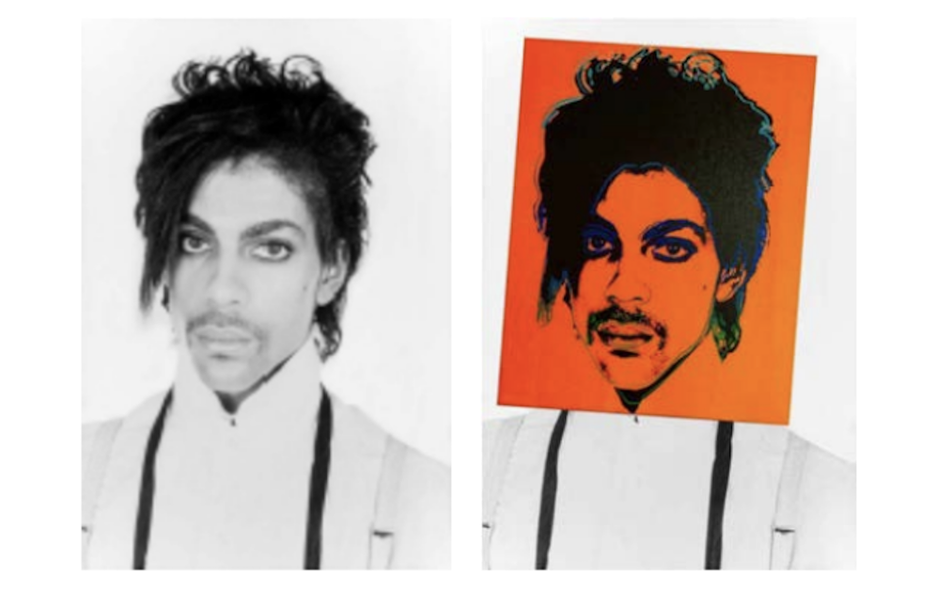
Figure 1: Goldsmith’s original image and Warhol’s treatment superimposed on top.[39]
Hypothetical: Swift v. Rodrigo
In 2019, Taylor Swift released her album Lover, which included the notable hit, Cruel Summer.[40] During the bridge, Swift exclaims, “I love you ain’t that the worst thing you ever heard?!”[41] Having been inspired by the composition and the “screamy” quality of Swift's delivery, Rodrigo included a very similar bridge on her hit song deja vu.[42] In the bridge, she exclaims with a similar cadence, “Now everything is all reused!”[43] Swift never took Rodrigo to court for the similarity, but quietly obtained writing credits (and royalties!) on Rodrigo’s song.[44]
If Swift had sued Rodrigo for copyright infringement in a post-Warhol world, what might courts consider about a fair use defense by Rodrigo?
To understand how the courts would approach this question, it is helpful to know the type of borrowing Rodrigo employed in deja vu.[45] The U.S. Copyright Office defines the integration of old music into new works as sampling or interpolation.[46] To sample, an artist takes part of an existing sound recording and puts it in their new work.[47] To interpolate, an artist takes the existing music and rerecords it to be inserted into the new work.[48] An interpolation may sound identical or different from the original work. The key difference between sampling and interpolation is rerecording.[49] In deja vu, Rodrigo interpolated Swift’s Cruel Summer, so the bridge is not an exact copy.[50] However, since Rodrigo’s bridge is technically derivative, Rodrigo’s song infringes on Swift’s rights under copyright law.[51]
In a hypothetical case where Swift had sued Rodrigo for copyright infringement, Rodrigo might rely on fair use to escape liability for the similarities between their respective songs.[52] The court would have to apply the Copyright Act’s fair use analysis and decide based on all four factors, since no one is dispositive.[53]
Before Warhol, courts might have found Rodrigo’s hypothetical fair use defense more plausible.[54] Rodrigo changed the “purpose and character” of Swift’s work by using different lyrics and changing the meaning of the original work.[55] Though both songs were commercial, the change in meaning may have reduced the weight of a commerciality analysis.[56] Both Swift’s and Rodrigo’s songs are published, creative expressions, leaving no issue as to the “nature” of the works.[57] In addition, Rodrigo did not use a substantial portion, or take the heart of Swift’s work in Cruel Summer. Rodrigo used one phrase’s cadence out of the whole song; and likely did not take any money away from Swift as a result of her infringement.[58] Rodrigo may have very well gotten away with a fair use defense pre-Warhol.[59]
Post-Warhol, the analysis shifts. Courts now emphasize the first factor: “(1) the purpose and character of the use,” and consider if the use is for commercial or nonprofit educational purposes.[60] Now, derivative works must be substantially different from the original work, and be used for a different purpose than the original.[61] Rodrigo did not substantially change her phrase’s cadence from Swift’s (note: the degree of difference in Warhol’s and Goldsmith’s work, which was found to be substantially similar). Additionally, Rodrigo created the song for the same purpose as Swift—to make money from music.[62] It would not matter if Rodrigo effectively changed the meaning of the cadence, because that inquiry ventures too close to artistic judgment, which judges are meant to avoid.[63] After Warhol, what qualifies as fair use is up in the air, and results will vary based on the facts.[64] Today, Rodrigo might have a “Cruel Summer” arguing the defense of fair use.[65]
Conclusion
So, what does the Supreme Court’s opinion in Warhol mean for sampling or interpolating music? The future is unclear.[66] The holding might lead to hindering “the progress of…useful Arts,” as outlined in the Constitution.[67] But, it might also lead to stronger protection for authors of original expressions.[68] The safest bet would be to avoid using copyrighted work altogether, or to get a license—permission to use the music from the author of the original work.[69] If fair use has to be relied on, the Copyright Act and the Warhol opinion are good resources to refer to, but you’ll never truly know if a fair use defense will work until you find yourself in court.[70]
[1] Andy Warhol Found. for the Visual Arts, Inc. v. Goldsmith, 598 U.S. 508, 550 (2023).
[2] 17 U.S.C.S. § 107.
[3]Andy Warhol Found. for the Visual Arts, Inc., 598 U.S. at 508.
[4] 17 U.S.C. § 106.
[5] 17 U.S.C.S. § 101. (emphasis added)
[6] Stephen Wolfson, How an Andy Warhol Photo Might Impact the Future of Music Sampling, Univ. of Pa. Libr. (Jan. 5, 2024), https://www.library.upenn.edu/news/copyright-and-music#:~:text=But%20there%20are%20at%20least,because%20someone%20asks%20for%20it.
[7] 17 U.S.C.S. § 107.
[8]Andy Warhol Found. for the Visual Arts, Inc., 598 U.S. at 527.
[9]Id.
[10]Id.
[11]Id. at 527-28.
[12] 17 U.S.C.S. § 107.
[13]Andy Warhol Found. for the Visual Arts, Inc., 598 U.S. at 523.
[14] 17 U.S.C.S. § 107.
[15] 17 U.S.C.S. § 107.
[16]Andy Warhol Found. for the Visual Arts, Inc., 598 U.S. at 523.
[17] 17 U.S.C.S. § 107.
[18]Andy Warhol Found. for the Visual Arts, Inc., 598 U.S. at 523.
[19] Wolfson, supra note6.
[20] Robert J. Labate, Tanisha Pinkins & Cindy A. Gierhart, U.S. Supreme Court Holds That First Factor of Fair Use Test Favors Photographer, Holland & Knight LLP (June 15, 2023), https://www.hklaw.com/en/insights/publications/2023/06/us-supreme-court-holds-that-first-factor-of-fair-use#:~:text=fair%20use%20analysis.%22-,In%20a%207%2D2%20decision%2C%20the%20U.S.%20Supreme%20Court%20in,works%20that%20are%20in%20dispute.
[21] Campbell v. Acuff-Rose Music, Inc., 510 U.S. 569, 580 (1994).
[22]Id. at 579.
[23] Id.
[24] Id.
[25] Andy Warhol Found. for the Visual Arts, Inc., 598 U.S. at 508.
[26] Id.
[27] Id.
[28] Id.
[29] Id.
[30] Id.
[31]Id. at 545.
[32] Id. at 525.
[33] Id. at 512.
[34] Id.
[35]Id. at 551.
[36]Id. at 522.
[37]Id. at 538.
[38] Wolfson, supra note6.
[39]Andy Warhol Found. for the Visual Arts, Inc., 598 U.S. at 522.
[40] Taylor Swift, Cruel Summer, on Lover (Republic Records 2019).
[41]Id. at 1:59.
[42] Olivia Rodrigo, deja vu, on Sour (Geffen Records / Interscope Records 2021).
[43]Id. at 2:57.
[44] Sarah Anderson, Is Olivia Rodrigo’s alleged interpolation of Taylor Swift’s music copyright infringement?, Music Infringement, Art, & The Law (Nov. 23, 2021), https://musicinfringement.art.blog/2021/11/23/is-olivia-rodrigos-alleged-interpolation-of-taylor-swifts-music-copyright-infringement/#_ftnref10.
[45] Rodrigo, supra note 44.
[46] U.S. Copyright Office, Sampling, Interpolations, Beat Stores and More: An Introduction for Musicians Using Preexisting Music, at 3, 5 (rev. Dec. 2021), https://www.copyright.gov/music-modernization/educational-materials/Sampling-Interpolations-Beat-Stores-and-More-An-Introduction-for-Musicians-Using-Preexisting.pdf.
[47] Id. at 3.
[48] Id.
[49] Id. at 5.
[50] Swift, supra note 42.
[51] 17 U.S.C. § 106.
[52] 17 U.S.C. § 107.
[53] Andy Warhol Found. for the Visual Arts, Inc., 598 U.S. at 550-51.
[54] 17 U.S.C. § 107.
[55] Rodrigo, supra note 27; Swift, supra note 25; 17 U.S.C. § 107.
[56]Rodrigo, supra note 27; Swift, supra note 25; 17 U.S.C. § 107.
[57]Rodrigo, supra note 27; Swift, supra note 25; 17 U.S.C. § 107.
[58] Anderson, supra note 46; Rodrigo, supra note 27; Swift, supra note 25; 17 U.S.C. § 107.
[59]Andy Warhol Found. for the Visual Arts, Inc., 598 U.S. 508.
[60] 17 U.S.C. § 107.
[61] Labate et al., supra note 21.
[62]Andy Warhol Found. for the Visual Arts, Inc., 598 U.S. at 522.
[63]Id. at 545.
[64] Labate et al., supra note 9; Judy Jennison & Lisa T. Oratz, Sign O’ the Times: Supreme Court Rules in Warhol v. Goldsmith, Perkins Coie (July 6, 2023), https://perkinscoie.com/insights/update/sign-o-times-supreme-court-rules-warhol-v-goldsmith#:~:text=Takeaway,against%20other%20considerations%2C%20including%20commercialism.
[65] Wolfson, supra note6.
[66] Wolfson, supra note6; Paul Matenaer, The Supreme Court Strikes a New Chord in Andy Warhol Foundation v. Goldsmith, Axley Brynelson, LLP(Aug. 11, 2023), https://www.axley.com/publication_article/andy-warhol-foundation-v-goldsmith/#:~:text=The%20impact%20of%20the%20holding,Much%20remains%20to%20be%20seen.
[67] U.S. Const. art. I, § 8, cl. 1.
[68] Wolfson, supra note6.
[69] Wolfson, supra note6; Matenaer, supra note 68.
[70] U.S. Copyright Office, supra note 34, at 10.